
KAIWEETS Digital Laser Tachometer
4.8Editor score
Non-contact RPM measurement
Large backlit LCD display
Portable and easy to use
Discover the top laser tachometers for accurate RPM readings. This guide compares features, accuracy, and ease of use for professionals and DIYers alike.
Finding the right tool to measure rotational speed is essential for maintaining machinery and ensuring safety. A laser tachometer provides non-contact measurements, allowing you to check motors and fans without stopping operations or risking injury from moving parts.
We evaluated ten top-rated models based on accuracy, range, display clarity, and ease of use. Each product was reviewed for its ability to deliver consistent results across various applications, from automotive diagnostics to industrial maintenance tasks and home workshops.
Each pick highlights specific strengths to help you match the tool to your needs. Remember that prices and availability can change, so always verify the latest details on the product page before making your final decision for your next project.
4.8Editor score

4.6Editor score

4.2Editor score
This side-by-side comparison details the key specifications and capabilities of each selected tachometer. Reviewing these details helps you understand how each device performs in real-world scenarios and which features matter most for your specific work environment.




The Extech 461920 is a top-rated laser tachometer known for its reliability and ease of use. With a rating of 4.6 stars, it stands out for providing accurate RPM measurements from 2 to 99999 using non-contact laser technology. Its large backlit LCD makes reading results straightforward even in dim workshops.
We may earn a commission when you buy through this link, at no additional cost to you.
Key strengths include its high accuracy of plus minus 0.05 percent and 0.1 RPM resolution which ensures precise data for maintenance tasks. The ergonomic double-molded housing fits comfortably in one hand, reducing fatigue during long inspection sessions. Additionally, the device stores Min Max and Last values allowing for quick recall without needing external notes.
While the device performs exceptionally well, users must note that reflective tape is required for some non-reflective surfaces which can be a minor inconvenience. Also, it runs on a single 9V battery which is not rechargeable meaning you need spares for heavy daily use. These trade-offs are acceptable given its professional-grade performance and robust build.
This tachometer is ideal for HVAC technicians automotive mechanics and industrial maintenance teams who need dependable readings. If you prioritize accuracy and a user-friendly interface for general rotating speed checks, this model offers excellent value and should be at the top of your list for reliable field work.
Measures rotating objects safely from a distance using laser targeting which protects users from moving parts.
Stores Min Max and Last values on the display so you can review critical readings without writing them down.
We may earn a commission when you buy through this link, at no additional cost to you.
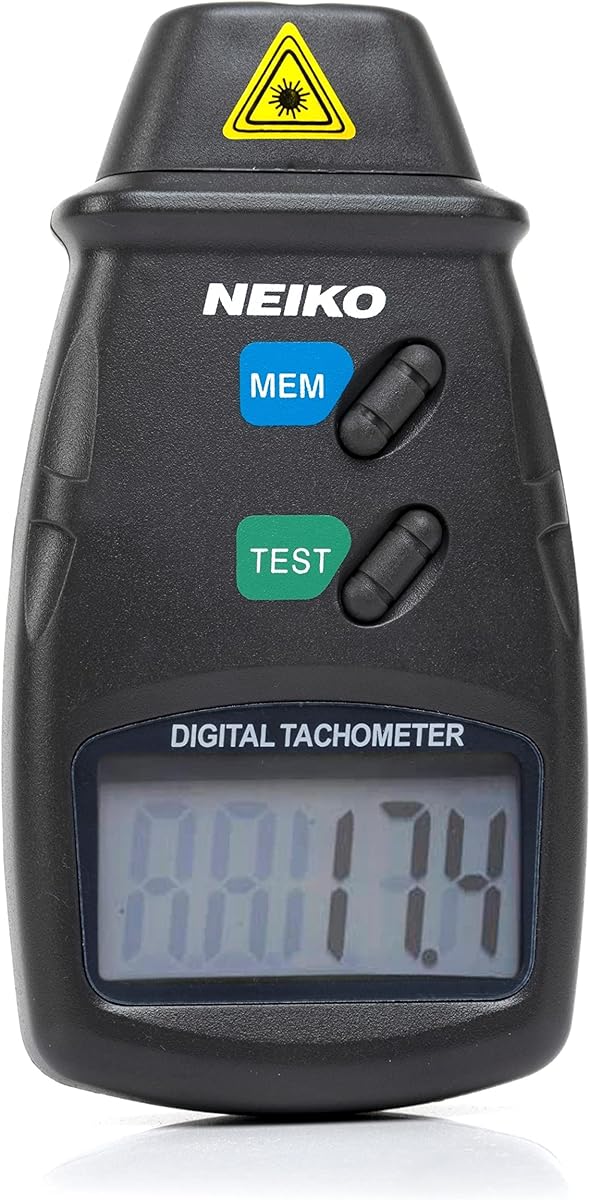
The NEIKO 20713A is a handheld digital tachometer designed for measuring RPM on revolving shafts like automotive driveshafts. It offers a rating of 4.2 stars and provides instant readings from 2.5 to 99999 rpm using high-speed laser aim. The large LCD screen makes it easy to read velocity in revolutions per minute clearly.
We may earn a commission when you buy through this link, at no additional cost to you.
This device is highly accurate with plus minus 0.05 percent precision and measures at a distance from 2 to 20 inches. It measures revolutions over a 1-second sampling time and stores results as last minimum or maximum readings which is helpful for trend tracking. The compact pocket radar design makes it easy to carry for diagnostic purposes on site.
One limitation is that the measurement distance is limited to 20 inches which might be tight for larger motors or restricted spaces. Additionally while accurate for shafts it may require reflective tape on smooth surfaces which adds a small setup step. These constraints are manageable for users focused on automotive or small engine maintenance tasks.
Buy this if you need a dedicated tool for automotive RPM checks where speed and portability matter. It serves well for mechanics who want quick reliable data without complex setup and the included batteries mean you can start using it right away.
Built to measure revolving shafts like driveshafts making it perfect for car engine diagnostics and tuning.
Lightweight and pocket-friendly design allows technicians to carry it easily in their toolbox for quick jobs.
We may earn a commission when you buy through this link, at no additional cost to you.
The Extech RPM33 is a combination contact and laser photo tachometer offering versatility for both RPM and linear speed. Rated at 4.2 stars it allows seamless switching between non-contact laser measurement and mechanical contact testing for diverse tasks. The high-intensity laser enables safe readings from up to 1.6 feet away for dangerous equipment.
We may earn a commission when you buy through this link, at no additional cost to you.
Its microprocessor-based design achieves industry-leading accuracy of 0.05 percent thanks to a quartz crystal oscillator. It stores up to 10 data sets tracking current max min and average values so you can analyze performance over time easily. The included soft carrying case keeps your precision optics protected during transport to job sites.
The premium price may be a barrier for casual users and the contact mode requires a learning curve to align the wheel correctly on belts. However for maintenance teams needing reliable metrics on conveyors and elevators these factors are minor compared to the versatility gained. The ability to measure both surface speed and RPM in one device is a major advantage.
This tool is perfect for laboratory grade precision needs and industrial maintenance teams managing multiple equipment types. If you value data recording capabilities and the flexibility of dual modes the Extech RPM33 provides a robust solution that justifies its higher cost with professional performance and durability.
Switch between laser for RPM and contact wheel for linear belt speed without needing separate tools.
Stores 10 complete data sets including averages which supports detailed equipment performance analysis.
We may earn a commission when you buy through this link, at no additional cost to you.
The Monarch PLT200 is a pocket laser tachometer that stands out for its NIST-traceable calibration certificate ensuring it meets manufacturer specifications out of the box. With a perfect 5.0 rating it is ideal for users who need compliant measurements for quality system standards. The Class 2 laser beam works safely at distances up to 25 feet.
We may earn a commission when you buy through this link, at no additional cost to you.
The LCD screen presents test results and units clearly with on-target and low battery indicators for ease of use. Conforming to NIST standards and EU Directives this device is ready for rigorous environments where documentation and accuracy are critical. Its simple design focuses on delivering reliable data without unnecessary complications.
While it lacks data memory functions found in higher-end models this simplifies operation and reduces cost for users who record results manually. The premium price reflects the calibration and compliance features which are necessary for regulated industries. For tasks requiring verified accuracy without complex data tracking this model is an excellent choice.
Buy this if you work in quality control or regulated industries where instrument calibration is mandatory. Its readiness for immediate use and long measurement distance make it a reliable partner for inspection teams needing trustable data without extensive setup.
Comes with a new NIST-traceable calibration certificate to assure you that measurements meet strict standards.
Measures up to 25 feet away allowing you to stay safely away from high-speed rotating machinery.
We may earn a commission when you buy through this link, at no additional cost to you.
The KAIWEETS Digital Laser Tachometer offers professional high accuracy RPM testing at an affordable price. With a rating of 4.8 stars it measures rotational speed from 10 to 99999 RPM with plus minus 0.05 percent precision. Its safe non-contact laser technology is perfect for testing motors fans and pulleys without touching rotating parts.
We may earn a commission when you buy through this link, at no additional cost to you.
The large backlit LCD display ensures clear visibility in low-light garages and workshops. Compact handheld design allows one-hand operation with simple button controls for quick mode switching. Features like auto shut-off and low battery indicator add dependability for daily use at home or on job sites.
While it lacks the advanced memory functions of premium models its simplicity and cost-effectiveness make it ideal for DIYers and casual technicians. The minimum range starts at 10 RPM which may miss very slow speeds but covers most common applications. This trade-off is acceptable for those seeking reliable basic performance without high cost.
This is the go-to choice for homeowners and small shop owners needing accurate RPM checks without breaking the budget. Its combination of high accuracy and ease of use makes it a favorite for general equipment troubleshooting and maintenance tasks.
Delivers professional precision at a budget-friendly price making advanced tools accessible to everyone.
Simple button controls and clear display make it easy to use even for beginners.
We may earn a commission when you buy through this link, at no additional cost to you.
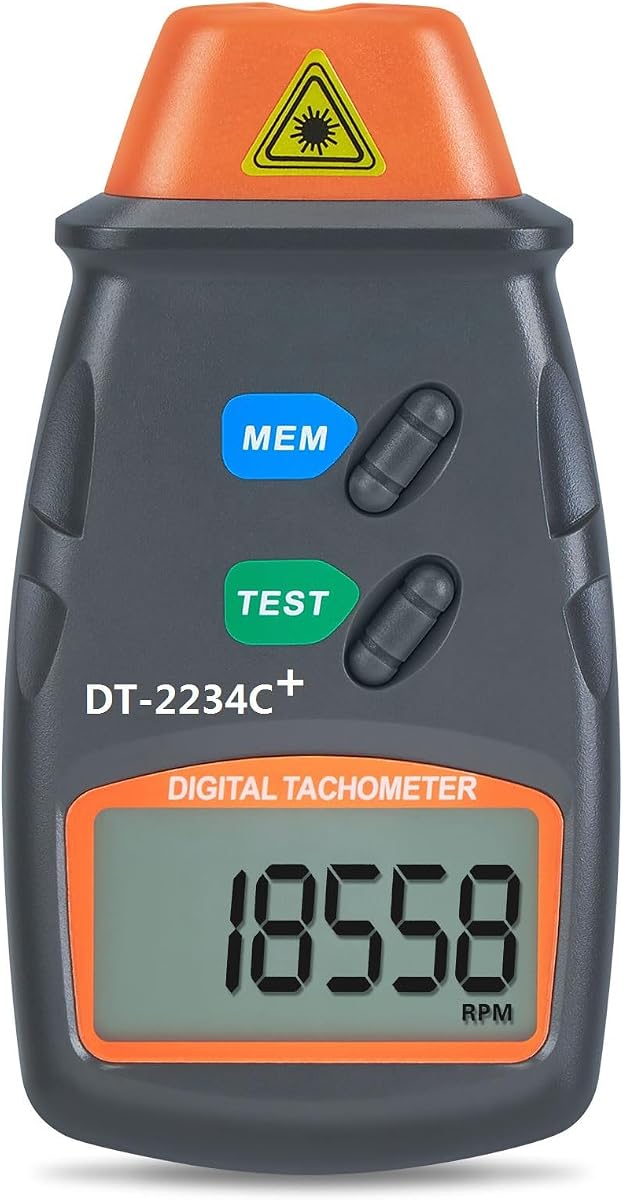
This KAIWEETS digital tachometer features a clear 40mm 5-digit LCD screen and accurate readings with plus minus 0.05 percent plus 1. It offers auto-ranging to save effort and measures from a distance up to 1000mm for hard-to-reach equipment. Dual modes support RPM and counting with resolutions as fine as 0.1 RPM for detailed monitoring.
We may earn a commission when you buy through this link, at no additional cost to you.
The Max Min and AVG functions help you capture critical data points without manual note-taking. Its compact lightweight design weighs only 140g including batteries making it easy to carry on the go. Powered by 3 AAA batteries it balances performance with portability for workshop and garage use.
The need for reflective tape and specific distance parameters means you must prepare surfaces before use. Also battery life may vary depending on usage intensity but remains standard for this class. These factors are manageable given the versatile feature set that supports both professional and DIY projects.
Choose this if you need a lightweight tool with data tracking capabilities for tuning engines or checking machinery. The auto-ranging and clear display make it simple for all skill levels to get precise results reliably in various settings.
Automatically selects the optimal range to save you time and eliminate manual adjustments.
Tracks Max Min and Average values to support deeper analysis of equipment performance over time.
We may earn a commission when you buy through this link, at no additional cost to you.
AGPtek Professional Digital Laser Photo Tachometer is designed for automotive technicians HVAC professionals and DIY enthusiasts. It offers a wide measuring range from 2.5 to 99999 RPM with high resolution options of 0.1 or 1 RPM. The ergonomic lightweight design reduces fatigue during prolonged inspections on site.
We may earn a commission when you buy through this link, at no additional cost to you.
It measures distances between 50 and 500mm which suits many common mechanical checks. Reflective tape must be attached to measure RPM on most surfaces but the kit includes 3 strips of high-adhesion tape to help you get started. A durable blue storage bag protects the device from dust and impacts in your toolbox.
The lack of a backlight might make reading difficult in very dark conditions and the measurement distance is capped at 500mm. These limits are acceptable for close-range work but might be challenging for larger industrial settings. Still the included accessories make it a ready-to-use kit for immediate tasks.
This is a solid option for users who want a complete package with protective storage and basic high-speed measurement. If you work mostly in accessible locations with adequate lighting this tool provides reliable performance for standard RPM needs.
Comes with reflective tape and a storage bag so you can start measuring right away without extra purchases.
Lightweight and comfortable in hand to reduce fatigue during long inspection periods.
We may earn a commission when you buy through this link, at no additional cost to you.
KAIWEETS Laser Tachometer integrates microcontroller technology and photoelectric sensing for consistent accurate RPM readings. It features an ultra-large 5-digit 40mm screen for clear results even in low light. The memory function automatically stores Max and Min values so you can track rotational speed trends without manual recording.
We may earn a commission when you buy through this link, at no additional cost to you.
Smart power management includes low battery alerts and automatic shutdown after four minutes of inactivity to save battery life. Powered by a 9V battery it is compact and ergonomic for industrial lab or home use. Reflective tape is included to help you measure on smooth surfaces quickly.
Despite the useful features some users report occasional variability in readings which can affect confidence for critical applications. The resolution changes at 10000 RPM which is standard but may need attention for high-speed precision work. These trade-offs are common at this price point and acceptable for general maintenance.
Choose this if you want a handheld device with built-in memory features and clear visibility for engine testing. It is well-suited for workshop use where tracking max min values helps diagnose performance issues without external tools.
Simplifies testing by automatically storing maximum and minimum rotational speed values for review.
Shuts off after four minutes to extend battery life and reduce waste during intermittent use.
We may earn a commission when you buy through this link, at no additional cost to you.
This 2-in-1 digital tachometer combines contact-type measurement from 3 to 19999 RPM and non-contact laser technology from 3 to 99999 RPM. With an impressive plus minus 0.05 percent accuracy it is a professional choice for automotive maintenance and industrial machinery diagnostics. The backlight function ensures visibility in various lighting conditions.
We may earn a commission when you buy through this link, at no additional cost to you.
Rapid sampling time of 0.8 seconds for speeds above 60 RPM allows real-time data efficiency for tuning or checks. It includes Max Min and Hold data functions for comprehensive analysis. The flexible measuring distance from 50 to 500mm ensures you can capture accurate readings across different equipment sizes.
Contact mode may lead to wear on the wheel if used frequently on rough belts and reflective tape is required for laser use. These considerations are standard for hybrid tools and do not impact the overall utility for varied testing needs. The compact handheld design makes it easy to carry for on-site engine work.
Buy this if you need a single tool that handles both direct contact and laser measurements for car engines and machinery. Its versatility and data functions make it a practical choice for professionals who face diverse measurement tasks daily.
Use contact for direct RPM and laser for non-contact in one unit to simplify your toolkit.
Captures data in 0.8 seconds for real-time feedback during dynamic testing scenarios.
We may earn a commission when you buy through this link, at no additional cost to you.
The Triplett TA200 Contact and Non-Contact Laser Photo Tachometer is built for robust industrial environments. It features a 5-digit backlit LCD display for clear readings and supports both contact and non-contact modes for versatile testing. Triplett is known for professional grade construction that withstands daily use on factory floors.
We may earn a commission when you buy through this link, at no additional cost to you.
Designed for industrial use it prioritizes durability and reliability over extra frills. The dual mode allows you to choose the best method for each situation whether it is a high-speed belt or a motor shaft. While detailed specs are minimal the brand reputation suggests trust in its performance under stress.
Users may find limited information on memory or advanced functions compared to digital competitors but the core measurement tasks are handled well. The price reflects the professional target market and may be higher than consumer models. For heavy industrial use this focus on basics and durability is often preferred.
Choose this for factory maintenance or workshops where ruggedness and dual functionality are key priorities. It offers a reliable foundation for routine RPM checks where brand trust and build quality are more important than digital data tracking.
Constructed to withstand the rigors of daily factory floor use and harsh environments.
Switch between contact and laser modes to adapt to different measurement requirements quickly.
We may earn a commission when you buy through this link, at no additional cost to you.
Selecting the right laser tachometer depends on your specific needs and environment. This guide breaks down the essential factors to consider so you can find a tool that delivers accurate and reliable results for your projects.
Look for a tachometer that covers the RPM speeds you expect to encounter most frequently. A range of 2 to 99999 RPM is common but some models start higher or offer finer resolution for very slow speeds. Resolution determines how small a change the device can detect and is critical for precision work.
Ensure the device offers both minimum and maximum ranges that fit your typical tasks to avoid limitations in the field.
Accuracy is typically expressed as a percentage plus a fixed value like plus minus 0.05 percent. Higher accuracy is essential for critical maintenance or quality control applications where small deviations matter. Check if the device uses a quartz crystal oscillator which helps maintain consistent performance over time.
Prioritize models with stated accuracy specs that match your industry standards to ensure trustable measurements.
Non-contact laser measurements allow you to measure speed without touching moving parts which increases safety. Contact modes require physical contact with a wheel and can be better for linear speed or very slow RPM. Some tools offer both modes providing flexibility to handle different surfaces and equipment types.
Choose a model with dual modes if you work with varied machinery or need to measure belt speeds directly.
A large backlit LCD display makes it easy to read results in dim workshops or outdoor conditions. Look for 5-digit screens that show numbers clearly without strain. Some models also display Min Max and Hold values which help you analyze data without notes.
Clear display features save time and reduce errors when recording measurements during busy shifts.
Memory functions that store Max Min and Last values are useful for tracking equipment performance trends. Some tachometers store multiple data sets which helps when you need to compare readings over time. Basic models may lack this feature requiring you to note results manually.
If you need to analyze data trends look for a device with built-in memory storage capabilities.
Ergonomic handheld designs reduce fatigue during prolonged use in the field. Rugged housing protects the optics from bumps and dust which extends the life of the tool. Lightweight construction makes it easy to carry in a pocket or toolbox.
Select a unit that feels balanced in hand and offers a protective case if you travel to job sites regularly.
Most tachometers run on standard batteries like 9V or AAA which are easy to replace. Auto shut-off features help conserve power when the device is not in use. Check if low battery indicators are present so you can replace them before a job interruption.
Consider how long the tool lasts on a single charge or battery to plan for maintenance during long shifts.
Many kits include reflective tape which is necessary for measuring smooth surfaces accurately. Some also come with carrying cases storage bags or user manuals to help you get started quickly. Extra accessories can add value and reduce initial setup costs.
Verify that reflective tape and a case are included if you expect to measure diverse surfaces often.
To use a laser tachometer, first turn it on and aim the laser beam at a reflective surface on the rotating object. If the surface is smooth, apply a small piece of reflective tape provided in the kit to ensure the sensor detects the rotation clearly.
Keep the device at a stable distance within the recommended range, typically between 50mm and 500mm for most units. Press the measurement button to capture the RPM reading which will display on the LCD screen instantly. Hold the device steady for a few seconds to allow the sampling time to complete.
Store the tachometer in a dry place away from extreme temperatures to protect the optics and electronics. Clean the lens gently with a soft cloth if it becomes dirty and replace the battery when the low indicator appears. Regular calibration checks ensure continued accuracy for your critical measurement tasks.
A laser tachometer measures the rotational speed of moving objects without physical contact. It is commonly used in automotive repair, HVAC maintenance, and industrial settings to check motors, fans, and pulleys. This non-contact method ensures safety and provides quick accurate readings.
Yes, most laser tachometers require a reflective spot on smooth surfaces to detect rotation. You can use the included tape or a small piece of reflective material. If the surface is already reflective like a polished metal, you may not need additional tape.
Non-contact tachometers use a laser beam to measure speed from a distance, while contact tachometers touch the object with a wheel. Contact models are useful for low speeds or linear velocity, whereas laser models are safer and faster for high-speed industrial applications.
Most high-quality laser tachometers offer an accuracy of plus minus 0.05 percent or better. This level of precision is sufficient for most industrial and automotive applications. Accuracy depends on the internal oscillator and the device's ability to maintain stability during use.
You can use them on most motors with rotating shafts or visible blades. Avoid measuring through safety guards or enclosed housings unless you have access to the shaft. Always ensure the laser beam is safely aimed at the rotating part without risk to users.
Many models offer memory functions that store Min Max and Last values. Some premium devices can save multiple data sets for analysis. Basic models may not have memory so you will need to write down readings manually during testing.
Battery life typically ranges from 10 to 20 hours of continuous use. Models with auto shut-off features can extend this by powering down when not active. Carry spare batteries if you work on long shifts to avoid interruptions during critical measurements.
Basic home use may not require frequent calibration but industrial settings often need NIST-traceable calibration. Some models come with a calibration certificate to verify accuracy. Regular checks ensure your readings remain precise over time.
We covered ten top laser tachometers ranging from budget options to professional-grade tools. The Extech 461920 stands out for overall reliability while the KAIWEETS Digital offers great value for everyday users. The Extech RPM33 is best for those needing both contact and laser flexibility.
When choosing prioritize accuracy range and ease of use based on your specific work environment. If you need safety and speed, a laser-only model works well. If versatility is key, a dual-mode device might be worth the extra investment for your toolkit.
Remember that prices and availability may change so always verify current details before purchasing. Check user reviews for the latest feedback on performance and support. With the right tool you can maintain your equipment efficiently and ensure safety on every job.