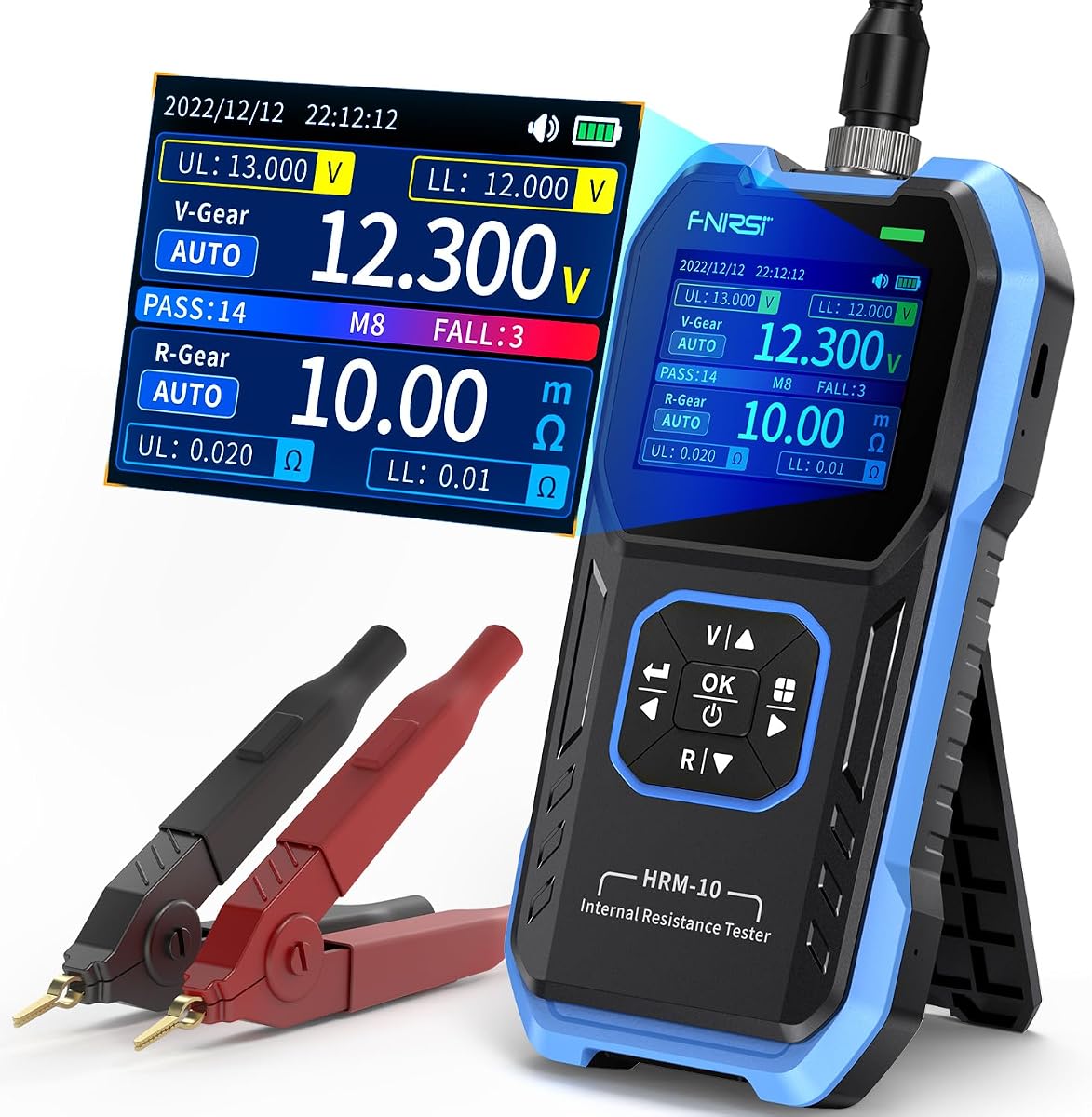
FNIRSI HRM-10
4.4Editor score
TFT HD color display
0-100V voltage range
0-200 ohm resistance
This comprehensive guide compares the top 10 Battery Internal Resistance Tester models available in October 2026 to help you find the most accurate and
Finding the right Battery Internal Resistance Tester is crucial for maintaining battery health across various applications. Whether you work with automotive systems or hobbyist projects, accurate diagnostics prevent unexpected failures and extend equipment life significantly.
We evaluated ten leading models based on measurement precision, user interface, durability, and versatility. Each product was assessed for its ability to handle diverse battery types while delivering reliable data for informed maintenance decisions in professional and DIY settings.
Each pick highlights unique strengths to help you match a device to your specific requirements. Prices and availability fluctuate frequently so always verify current listings before purchasing to ensure you get the best value for your investment today.
4.4Editor score

4.5Editor score

4.9Editor score
This side-by-side comparison highlights key specifications for all ten reviewed models to help you quickly identify which device meets your specific testing requirements.




The ZOYI ZT-XR1 stands out as a versatile tool combining a digital multimeter with a dedicated internal resistance tester. Its high 25000 count display ensures precise readings for both automotive and household battery diagnostics in demanding environments.
We may earn a commission when you buy through this link, at no additional cost to you.
With True RMS capability and 4-wire Kelvin sensing, this device delivers professional-grade accuracy. The integrated design saves space while offering extensive functions like capacitance and temperature measurement alongside battery health checks.
While it costs more than basic testers, the added features justify the investment for repair technicians. Users should note the auto power-off settings require adjustment to suit long testing sessions without interruption.
This model is ideal for electricians and hobbyists needing a compact multi-tool. Its reliability and comprehensive feature set make it a top recommendation for anyone prioritizing accuracy and efficiency.
By integrating a True RMS multimeter, this device eliminates the need for separate tools during diagnostics workflows.
The built-in 2000mAh battery supports continuous use up to ten hours with adjustable brightness and auto-off features.
We may earn a commission when you buy through this link, at no additional cost to you.
The FNIRSI HRM-10 delivers solid performance at an accessible price point making it perfect for general users. Its TFT HD color display provides clear visibility of test results compared to standard monochrome screens.
We may earn a commission when you buy through this link, at no additional cost to you.
Accurate measurement is achieved through the Kelvin four-wire connection method which minimizes wire resistance errors. It supports a wide voltage range of up to 100V suitable for many common battery applications.
While it lacks a rechargeable internal power source the device offers practical features like historical data recording. Users should ensure they connect only to DC sources to avoid damaging the unit during testing.
This unit is best for casual maintenance or entry-level professionals on a budget. Its simplicity and affordability make it a strong choice for basic battery health verification tasks.
The HD color screen enhances readability allowing users to quickly interpret voltage and resistance values even in bright conditions.
Stored records can be transferred to a PC via Excel enabling detailed analysis of battery performance over time.
We may earn a commission when you buy through this link, at no additional cost to you.
The RC3563 is a high-precision handheld analyzer favored for its advanced filtering algorithm that stabilizes readings. It is designed for laboratory or field work where consistent accuracy is critical for battery health assessment.
We may earn a commission when you buy through this link, at no additional cost to you.
Its ability to measure both internal resistance and voltage simultaneously allows for efficient diagnostics. The lightweight design ensures comfortable handling during extended testing sessions on various battery chemistries.
Users may find the battery capacity somewhat limited for heavy daily use but the 5V charging interface offers quick recharges. The learning curve for utilizing all features is manageable with proper manual review.
Ideal for researchers or professionals needing top-tier accuracy this device justifies its premium status. Its balance of performance and portability makes it a standout tool for specialized battery testing.
The Kalman filter mathematical algorithm improves measurement stability reducing noise for clearer results during dynamic testing.
Weighing only a few ounces this tester is easy to transport for field maintenance without compromising on technical capabilities.
We may earn a commission when you buy through this link, at no additional cost to you.
This universal tester is designed specifically for everyday battery sizes like AA and 9V making it ideal for home use. The rotary dial selection simplifies the process of matching the device to the battery type instantly.
We may earn a commission when you buy through this link, at no additional cost to you.
It provides capacity percentages and voltage readings to help users determine when replacement is truly needed. The large LCD screen ensures visibility in low light conditions during routine maintenance checks.
While not suited for industrial battery packs its reliability for small cells is commendable. Users should note the included batteries are for initial use only requiring replacement after extended testing periods.
For families or office managers managing small batteries this tool is practical and easy to use. Its straightforward design reduces confusion when checking power levels for toys or remote controls.
The rotary dial mechanism allows users to select the correct voltage range without complex digital menus or programming.
Showing percentage capacity helps prevent premature disposal of rechargeable batteries that still have significant life remaining.
We may earn a commission when you buy through this link, at no additional cost to you.
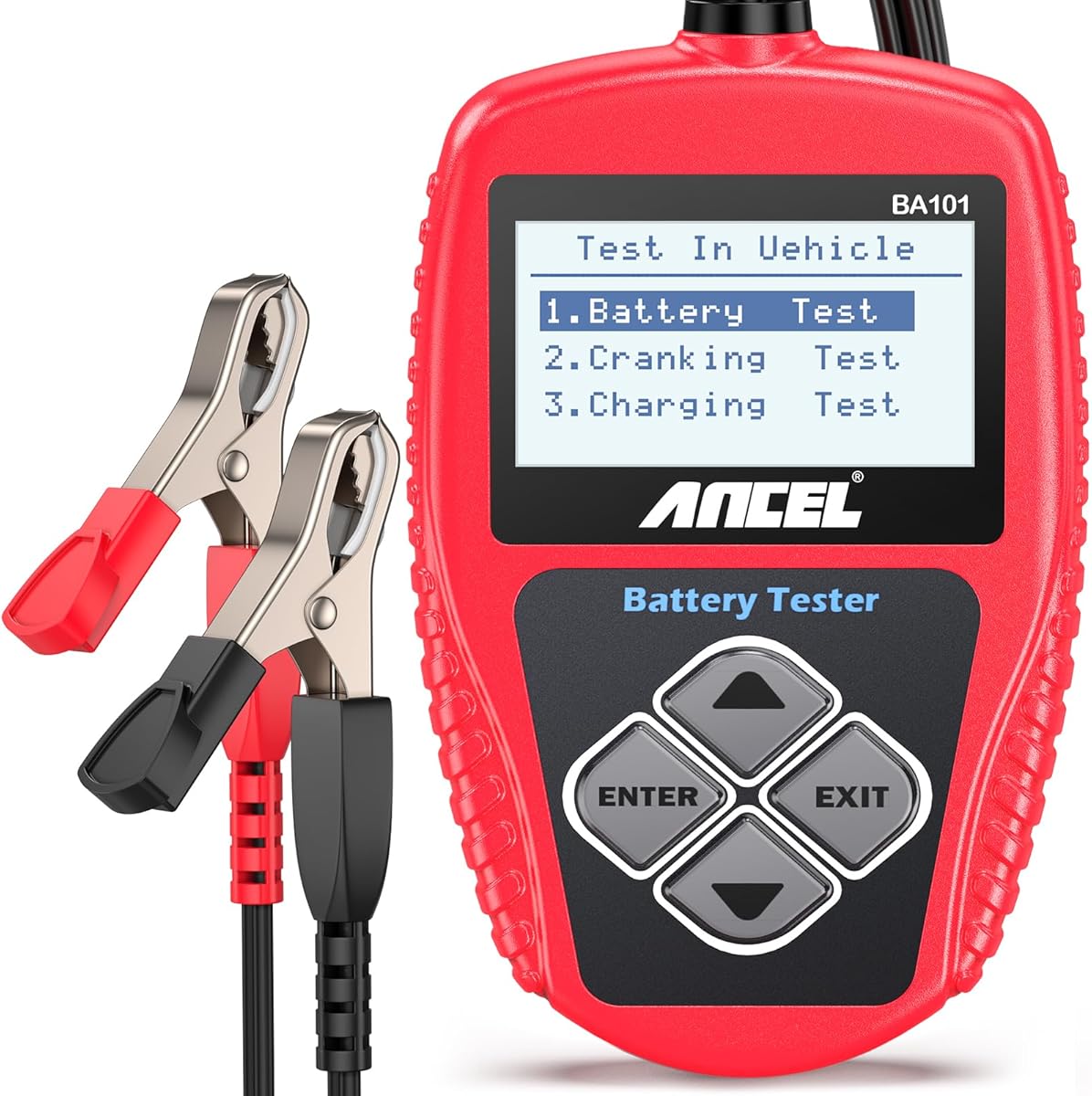
The ANCEL BA101 focuses exclusively on automotive 12V battery systems providing detailed health insights for vehicles. It evaluates state of health and charge levels to prevent unexpected breakdowns on the road.
We may earn a commission when you buy through this link, at no additional cost to you.
Its high copper clips and smart chip ensure accurate readings even in challenging environments. The device includes protection features that guard against common user errors like reverse polarity or short circuits.
While it does not support other battery types its automotive focus makes it a reliable garage tool. Users should ensure their vehicle fits within the 30Ah minimum capacity specification for optimal performance.
For car owners or mechanics dealing with standard vehicles this tester offers precise diagnostics. Its specialized design reduces confusion by focusing only on relevant automotive battery parameters.
Beyond voltage it analyzes the cranking and charging systems to give a full picture of vehicle electrical health.
Built-in protections prevent damage to both the device and the vehicle battery during testing in tight engine spaces.
We may earn a commission when you buy through this link, at no additional cost to you.
The ZOYI XR1 integrates a multimeter with battery testing capabilities offering a compact solution for electrical diagnostics. Its high-resolution display ensures users can read small resistance values with confidence.
We may earn a commission when you buy through this link, at no additional cost to you.
With Type-C charging and adjustable auto-off timers it balances modern convenience with energy efficiency. The device supports manual range adjustments to tailor testing to specific battery requirements accurately.
Although user reviews are mixed regarding stability it remains a capable tool for general maintenance. Users should check connections carefully to ensure the precision of the 4-wire Kelvin clips.
This device suits hobbyists looking for a single device to handle multiple electrical tasks. Its dual nature reduces tool clutter while providing essential data for battery and circuit checks.
The Type-C charging interface aligns with modern power standards making it easier to charge with common adapters.
Measuring down to 0.1 milliohms allows for detecting subtle degradation in battery internal resistance over time.
We may earn a commission when you buy through this link, at no additional cost to you.
The YR1035+ is a favorite among hobbyists testing small Li-ion or NiMH packs for RC models. It offers a true four-wire system that ensures accurate readings even for low resistance values.
We may earn a commission when you buy through this link, at no additional cost to you.
Its compact design allows it to fit easily into workbenches or field kits. The large LCD screen displays voltage and resistance simultaneously enabling quick decisions during battery configuration.
While it lacks advanced data logging the simplicity is often preferred for rapid testing sessions. Users appreciate the included clips and probes which are ready for immediate use upon unboxing.
Ideal for RC enthusiasts this tester provides the precision needed to maximize battery performance. Its user-friendly interface makes it accessible even for those new to resistance measurement.
Designed with RC enthusiasts in mind it handles the specific voltage and resistance ranges common in hobby batteries.
The lightweight construction ensures the device is easy to carry to workshops or field testing locations.
We may earn a commission when you buy through this link, at no additional cost to you.
The T-685 is designed for advanced testing with a resolution of 1 microohm suitable for precise lab environments. It supports both AC and DC resistance measurement offering versatility for detailed analysis.
We may earn a commission when you buy through this link, at no additional cost to you.
Its rapid testing speed of five times per second allows for efficient batch checks of battery packs. The USB port facilitates direct data transfer to computers for further study and reporting.
Despite its technical capabilities user feedback suggests limitations in usability or reliability. Those looking for professional grade data should verify compatibility with their specific testing protocols before purchase.
This tool is best reserved for specialized labs needing micro-resolution precision. It may not be necessary for general maintenance but excels in high-detail analysis applications.
With 1 microohm resolution this tester can detect minute changes in battery internal resistance that other devices might miss.
USB connectivity enables seamless integration with desktop software for detailed reporting and long-term tracking.
We may earn a commission when you buy through this link, at no additional cost to you.
This accessory kit expands the utility of the YR1035+ system with specialized clips for various battery terminals. It supports a wide voltage range and maintains high accuracy for both lead-acid and lithium batteries.
We may earn a commission when you buy through this link, at no additional cost to you.
The Type-C charging ensures the device stays ready for use with minimal downtime. Users appreciate the universal compatibility allowing them to test everything from button cells to large packs.
While it relies on the base tester it enhances the overall utility for varied testing needs. Proper connection of the Kelvin clamps is essential to maintain the high precision ratings.
For those investing in a YR1035 system this kit adds significant value. It ensures you have the right tools for different battery types without needing multiple separate devices.
Supporting everything from lithium to lead-acid batteries this kit adapts to various charging and maintenance scenarios.
The inclusion of a Type-C port aligns with current standards making it easy to power using standard phone chargers.
We may earn a commission when you buy through this link, at no additional cost to you.
The WESTOBIG Battery Tester offers a solid design with upgraded Kelvin four-terminal sensing for accuracy. It allows users to preset data sets which simplifies batch testing of multiple batteries in a single session.
We may earn a commission when you buy through this link, at no additional cost to you.
Its colorful display and automatic voltage gears make the interface friendly for users who prefer less manual input. The resistance gears provide flexibility to tailor the test to different battery chemistries.
While it requires some initial setup the saved presets streamline daily use. Users should ensure correct connection methods to maintain the precision offered by the four-terminal system.
Ideal for workshops testing multiple units daily this tool offers good efficiency. Its design prioritizes repeatable results making it suitable for quality control processes.
Saving up to eight data sets allows for quick checks against specific standards without resetting parameters each time.
The color display enhances readability ensuring users can distinguish between different test results quickly in any light.
We may earn a commission when you buy through this link, at no additional cost to you.
Selecting the right Battery Internal Resistance Tester depends on your specific application and technical requirements.
Look for devices that offer high resolution such as microohm or milli-ohm accuracy to detect subtle battery degradation over time. Proper precision ensures you catch failing batteries before they cause equipment failure or safety issues in critical systems.
Prioritize testers with clear precision ratings to match your application needs.
Ensure the tester supports the voltage levels of your batteries such as 12V automotive or up to 100V for larger packs. Exceeding voltage limits can damage the device and create safety hazards during testing procedures.
Check the max input voltage before purchasing to avoid equipment damage.
A four-wire Kelvin connection is essential for accurate low resistance measurement by eliminating wire and contact resistance errors. This method provides the most reliable data for battery health assessment compared to simple two-wire tests.
Always choose a tester with a Kelvin clip system for professional results.
Advanced models allow you to save and export test data to a computer for long-term analysis and reporting. This feature is useful for tracking battery performance over months or years to identify trends.
Opt for USB or Bluetooth connectivity if historical tracking is important.
Verify that the device supports the specific chemistries you use such as Li-ion, Lead-Acid, or NiMH to ensure accurate readings. Different batteries have different internal characteristics that require specific testing algorithms.
Confirm compatibility with your primary battery types before buying.
Consider whether you need a handheld battery-powered unit for field work or a mains-powered desktop for fixed labs. A rechargeable battery with Type-C charging provides flexibility and ensures you are not tethered to a wall outlet.
Choose a power source that fits your workflow environment.
A clear high-resolution display helps you read results accurately in bright sunlight or low light conditions. Color screens often provide better visual distinction between voltage and resistance values during testing.
Look for adjustable brightness to improve visibility in any setting.
Ensure the tester has appropriate safety ratings such as CAT II or CAT III if used in automotive or industrial environments. Proper protection prevents electrical hazards and extends the lifespan of the device.
Always check safety certifications before using in high-voltage areas.
Start by ensuring your tester is fully charged or powered and the correct battery type is selected on the device to avoid errors. Proper setup ensures accurate readings and prevents potential damage to the unit or battery during the process.
Connect the Kelvin clips firmly to the positive and negative terminals of the battery to eliminate contact resistance. Hold the probes steady until the reading stabilizes to capture the most precise internal resistance value.
Store the device in a dry environment and avoid exposing it to extreme temperatures or moisture to maintain calibration. Clean the probes regularly to remove residue that might interfere with future test accuracy.
Internal resistance testing measures the opposition to current flow within a battery to assess its health. Higher resistance often indicates aging or degradation which affects the battery's ability to deliver power efficiently. It is a key indicator of overall battery condition.
A four-wire Kelvin system uses separate leads for current and voltage to eliminate lead resistance from the measurement. This method ensures highly accurate readings especially for low-resistance values found in modern batteries. It avoids errors common in two-wire measurements.
Most universal testers support common types like Lithium and Lead-Acid but always check specifications before purchase. Some specialized models may only work with specific chemistries or voltage ranges. Verify compatibility to avoid errors.
Regular testing every six months or during routine maintenance is recommended for long-term battery health. Frequent use environments may require more frequent checks to catch issues early. Consistent testing helps prevent unexpected failures.
High resistance usually indicates the battery is old or damaged and may struggle to deliver full power. It can cause voltage drops under load leading to device failure. Replacing high resistance batteries is often necessary for safety.
Yes if the device is rated for automotive voltages and has safety features like reverse polarity protection. Always follow manufacturer guidelines to prevent short circuits or damage during testing. Safety ratings matter for vehicle systems.
Periodic self-calibration using the device's built-in function maintains measurement accuracy over time. Manufacturers recommend checking calibration annually or after dropping the unit. It ensures readings remain reliable for critical applications.
Many advanced testers connect to a PC via USB to transfer data for Excel spreadsheets. Check if the software is included or available online to analyze trends. Proper data export aids in long-term tracking.
We reviewed ten models ranging from affordable household testers to professional lab equipment. Each offers distinct features catering to different needs whether for automotive or industrial use.
Prioritize accuracy and safety when selecting a tester to ensure reliable results and safe operation. Consider your budget and required connectivity options to find the best fit.
Check current prices and availability as these details may change frequently on retailer websites. Always verify warranty terms before purchasing to protect your investment.