
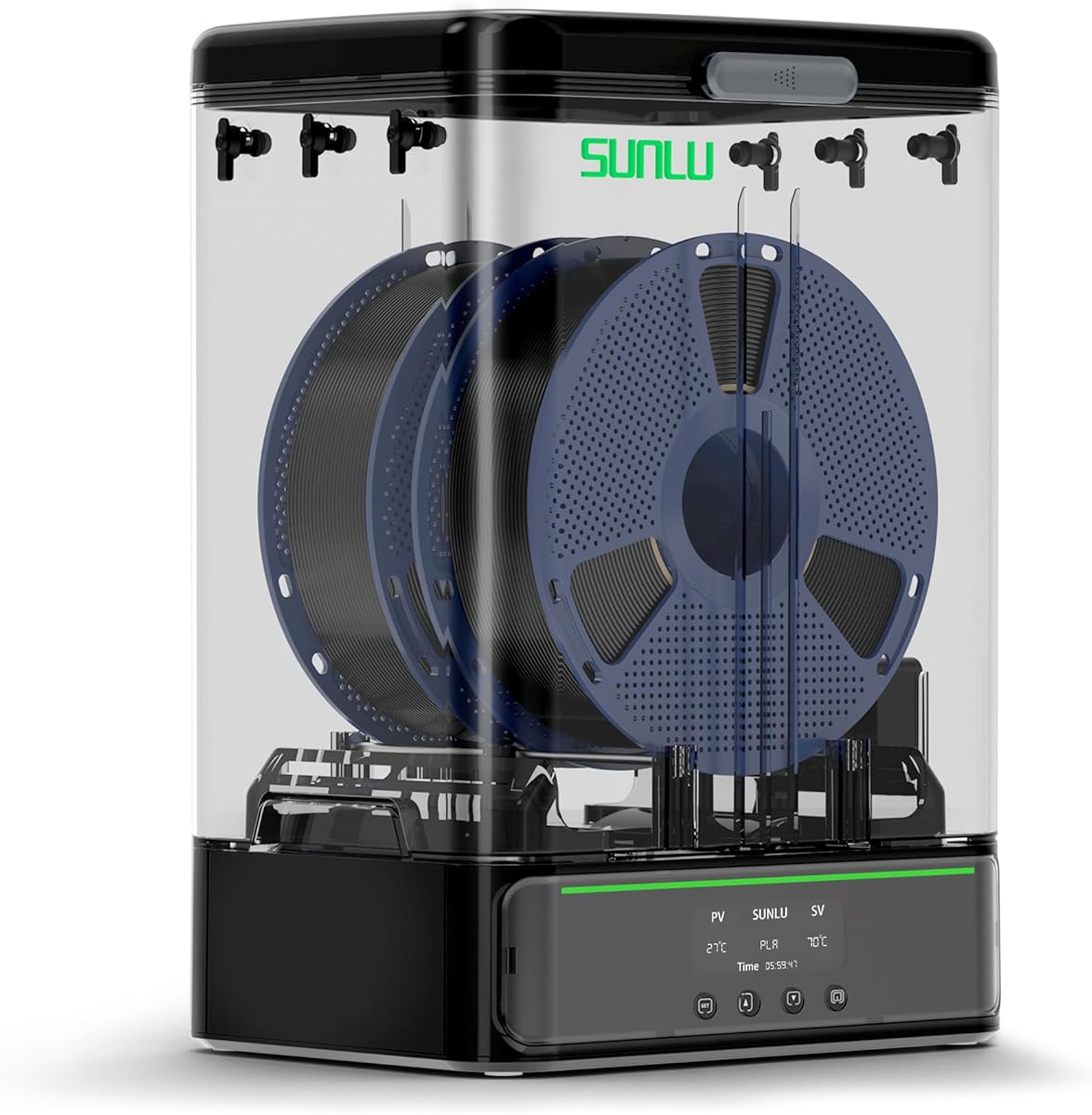
SUNLU S1 Plus
4.3Editor score
Integrated fan for airflow
LCD humidity and temp display
Wide filament compatibility
This guide compares the best filament dryer for 3D printing to help you choose the right drying and storage solution for your specific materials.
Filament dryers are essential tools for maintaining print quality by removing moisture from hygroscopic materials like PLA, PETG, and nylon. Without proper drying, prints can suffer from stringing, bubbling, and weak layer adhesion. Choosing the right dryer ensures your filament stays in optimal condition.
We compared ten top-rated filament dryers based on capacity, heating technology, temperature control, and user reviews. Our analysis covers budget-friendly options, multi-spool systems, and advanced models with humidity monitoring to help you find the best fit for your workshop needs.
Each pick highlights key features, pros, cons, and ideal use cases. Prices and availability change frequently, so check current listings before purchasing. Whether you need a simple box or a high-volume system, this guide simplifies the selection process.
4.3Editor score

4.6Editor score

4.5Editor score
The following table compares key specifications across all ten selected filament dryers. Use this side-by-side view to quickly assess capacity, heating power, and temperature ranges.



The Creality Space Pi X4 stands out as a top-tier filament dryer for 3D printing with its ability to hold four 1kg spools simultaneously. It features dual 200W heating chambers that reach up to 85 degrees C, making it suitable for both standard and engineering filaments.
We may earn a commission when you buy through this link, at no additional cost to you.
Its dual heating system removes moisture 30% faster than single-chamber dryers, significantly reducing wait times. The touch UI allows precise temperature settings, and the sealed enclosure maintains dry conditions during storage. This ensures consistent prints without stringing or bubbling.
While the price is higher than basic models, the speed and capacity justify the cost for frequent users. The large size requires dedicated space, but the illuminated window lets you monitor spools without breaking the seal. It is a robust investment for serious makers.
Buy this if you need high-volume drying for multiple filaments like ABS or PETG. The advanced features and reliability make it the best choice for those who prioritize quality and efficiency in their printing workflow.
Two independent heating chambers accelerate moisture removal, ensuring spools are ready quickly for printing.
Beyond drying, it acts as a storage box, keeping filament dry between prints without re-absorbing moisture.
We may earn a commission when you buy through this link, at no additional cost to you.
The SUNLU S1 Plus offers excellent value for beginners or casual users needing reliable filament drying. It includes an upgraded fan design that speeds up moisture discharge, addressing common issues like stringing and poor adhesion caused by wet filament.
We may earn a commission when you buy through this link, at no additional cost to you.
The 2-inch LCD screen displays temperature and humidity, allowing easy adjustments. It supports various materials from PLA to Nylon and accommodates different diameters. The personalized settings let you tailor the process to specific environmental conditions.
Its compact size fits well on smaller workbenches, though it holds only two spools. While it lacks advanced dual chambers, the fan ensures consistent airflow. This makes it a practical choice for those on a budget.
Choose this if you need a straightforward, cost-effective solution. It simplifies drying without complex features, making it ideal for hobbyists who want better print quality without overspending.
The added fan circulation ensures moisture leaves the chamber efficiently for faster drying times.
An LCD screen shows real-time data so you can monitor progress easily.
We may earn a commission when you buy through this link, at no additional cost to you.
The SUNLU S4 is a premium solution for high-volume printers requiring robust drying capabilities. It holds four 1kg spools and features a 350W PTC heater that offers higher efficiency and safety. Three circulation fans ensure consistent temperature across the entire chamber.
We may earn a commission when you buy through this link, at no additional cost to you.
Eight exit holes allow multiple printing setups or varied loading angles. The temperature range spans from 35 to 70 degrees C with a timer up to 99 hours. This flexibility supports a wide range of materials including TPU, Nylon, and PC.
Its size is notable, requiring significant space, but it is designed for dedicated labs. The unit can even be modified for larger rolls or other uses. The high power ensures rapid drying even for large spools.
Invest in this if you run a busy print farm or need to dry multiple materials at once. The reliability and capacity make it a top pick for professional environments.
The 350W PTC heater heats faster and more efficiently than standard models.
Eight exit holes provide flexibility for direct feeding to multiple printers simultaneously.
We may earn a commission when you buy through this link, at no additional cost to you.
The Comgrow SH01 provides a straightforward approach to filament drying and storage. It stores two 1kg spools and uses a gentle heating cycle up to 50 degrees C. The sealed box design prevents moisture re-absorption during storage, keeping spools fresh.
We may earn a commission when you buy through this link, at no additional cost to you.
A 2-inch LCD screen allows easy setting adjustments. The silicone cable sheath ensures smooth feeding and minimizes friction. It works well with standard materials like PLA, ABS, and PETG. The auto-shutdown feature saves power if idle.
While the temperature cap limits use for some advanced filaments, it suits most common needs. The build quality is solid, and after-sales support is available. It is a practical choice for small workshops.
Pick this if you want a hassle-free unit for standard filaments. Its simplicity and reliable sealing make it a good option for casual users who print frequently.
Sealing holes can be closed when not in use to maintain dryness for stored filament.
Touch buttons make it easy to set temperature and duration quickly.
We may earn a commission when you buy through this link, at no additional cost to you.
The Creality Space PI Plus introduces advanced heating technology with 360-degree hot air circulation for uniform drying. It features an 110W PTC heater that avoids uneven results from heating pads. A large 3.7-inch touch screen simplifies monitoring and control.
We may earn a commission when you buy through this link, at no additional cost to you.
One-key settings support up to 12 filament types, including composites like PLA-CF. The real-time humidity monitor helps track conditions without guesswork. This ensures prints remain consistent even in changing environments.
The 48-hour timer allows flexible scheduling, perfect for overnight drying. While it only holds two spools, the precision makes it valuable for high-performance materials. The design balances ease of use with technical features.
Choose this for demanding materials that need precise temperature control. The presets and humidity tracking save time and improve reliability for complex prints.
Quick settings for common filaments remove the need for manual temperature adjustments every time.
360-degree circulation ensures no cold spots, drying the entire spool evenly.
We may earn a commission when you buy through this link, at no additional cost to you.
The Polymaker Polydryer focuses on a seamless workflow from drying to storage. It allows direct feeding without breaking the seal, reducing exposure to ambient moisture. A built-in hygrometer lets you monitor humidity levels easily.
We may earn a commission when you buy through this link, at no additional cost to you.
The heated dock promotes even airflow to prevent localized drying issues. It supports PA Nylon, PETG, ABS, and others. The desiccant containers add extra defense against moisture between prints. This integrated approach simplifies management.
While it holds a single spool, the convenience of seamless transition is a major benefit. The lack of a digital screen keeps it simple but less customizable. It suits users who prefer straightforward setups.
This is ideal for those printing sensitive materials like Nylon. The storage and drying combo saves space and effort in maintaining filament condition.
Dry directly to storage and print without exposing filament to humidity between steps.
A built-in sensor helps track interior humidity to ensure dry conditions.
We may earn a commission when you buy through this link, at no additional cost to you.
The Creality Space Pi SE heats quickly with a built-in fan circulating hot air 360 degrees. It reaches 65 degrees C in 15 minutes, making it efficient for common filaments. The knob and screen offer simple, no-assembly operation.
We may earn a commission when you buy through this link, at no additional cost to you.
Real-time humidity monitoring helps track drying progress accurately. It supports a wide range of materials from PLA to Nylon. Thermal insulation keeps the exterior safe during use. Teflon tubes are included for smoother feeding.
The countdown timer shows remaining hours for precise control. Although limited to one spool, it fits well in compact spaces. It balances performance with ease of use for everyday printing.
Buy this for quick, reliable drying of standard spools. Its straightforward design and efficiency make it a solid choice for most users.
Fast warm-up time reduces wait periods before you can start printing.
Knob and screen combination allows easy temperature and time adjustments.
We may earn a commission when you buy through this link, at no additional cost to you.
This version of the SUNLU S4 offers high capacity for drying up to four 1kg spools. Its 350W PTC heater ensures safety and efficiency. Three circulation fans provide consistent temperatures across the chamber for even drying.
We may earn a commission when you buy through this link, at no additional cost to you.
Eight exit holes allow multiple printer connections or different loading angles. The timer ranges from 0 to 99 hours for flexibility. It supports diverse materials including PC and TPU. The design allows modifications for larger rolls or shoe drying.
The external dimensions are substantial, requiring ample workspace. However, the performance and capacity suit active printing environments. The included accessories help with initial setup quickly.
Select this if you manage multiple printers or large spools. Its power and flexibility support heavy-duty drying needs effectively.
Multiple fans ensure the entire chamber stays at the target temperature.
Eight holes support diverse feeding arrangements for complex printing setups.
We may earn a commission when you buy through this link, at no additional cost to you.
The SUNLU SP2 accommodates large 3kg spools in addition to standard 1kg rolls. Its 250W PTC heater reaches 70 degrees C in just 15 minutes. The 360-degree surround heating ensures even drying while running quietly.
We may earn a commission when you buy through this link, at no additional cost to you.
The drying unit detaches for use as a sealed storage box with sliding latches. This protects filament from moisture between sessions. An HD LCD screen displays temperature, time, and humidity clearly. It includes desiccant containers for extra defense.
Rollers inside the box hold various spool sizes securely. The transparency lets you check filament status without opening the lid. It combines functionality with a user-friendly design for versatile use.
Ideal for users with larger spools or multiple materials. The quick heat and storage features make it practical for busy workflows.
Rollers and holder design accommodate 3kg rolls plus smaller spools easily.
Separate base acts as a secure storage box once drying is complete.
We may earn a commission when you buy through this link, at no additional cost to you.
The SUNLU S2 is a straightforward unit designed to revive damp filament and improve print results. It includes a spindle that spins the filament continuously for even drying. The translucent lid lets you check progress without opening.
We may earn a commission when you buy through this link, at no additional cost to you.
A large touch screen allows easy customization of time and temperature. It supports materials like PLA and PETG comfortably. The internal volume fits standard spools well. The system is built to remove excess moisture effectively.
Its simplicity makes it accessible for beginners without overwhelming controls. It serves as both a holder and dryer simultaneously. While limited to one spool, it meets basic needs reliably.
Choose this for essential moisture removal without complexity. It provides solid performance for common materials at an accessible price.
The spinning mechanism ensures all sides of the spool dry evenly.
Check filament condition visually without breaking the dry environment inside.
We may earn a commission when you buy through this link, at no additional cost to you.
Choosing the right filament dryer involves considering capacity, heating speed, and material compatibility. These factors ensure you can dry spools efficiently while maintaining their quality.
Look for a dryer that fits the spool size you use most often. Some models hold one spool while others hold four or more. Consider the available desk space and the need to dry multiple types at once.
For high-volume printers, multi-spool units save time. For casual users, single units may suffice.
Different filaments require different temperatures. PLA needs lower heat while ABS or PC needs higher temps. Check that the dryer supports the full range of materials you print.
Select a unit with a max temp above 70C if you work with engineering plastics. Lower temp units work well for standard PLA.
PTC heaters offer faster, safer heating than standard coils. Models with 360 hot air circulation ensure even drying without hotspots. Check the wattage; higher watts mean faster warm-up times.
Opt for PTC with circulation fans for uniform results across the spool.
Dryers with LCD screens and hygrometers let you track humidity levels. This helps prevent over-drying or under-drying. Touch screens offer more precision than knobs.
Prioritize digital feedback if you work with moisture-sensitive materials like Nylon.
Some dryers double as sealed storage boxes to keep filament dry between prints. This avoids exposure to humidity after drying. Look for airtight seals and lid latches.
Integrated storage saves space and maintains filament condition long-term.
Ensure the dryer fits your filament diameter and weight. Some units include rollers for large spools. Check if they support PLA, PETG, TPU, or specialty filaments.
Verify compatibility before purchase to avoid sizing issues with your spools.
Consider how easy it is to set times and temperatures. Simple interfaces reduce setup time. Auto-shutdown features protect your equipment if left on accidentally.
User-friendly controls matter if you plan to use the dryer daily.
Budget models offer basic drying while premium units provide speed and capacity. Check for warranty and customer support options. Reliable after-sales service is valuable for long-term use.
Balance your budget against the features you need most for your workflow.
Place the filament spool inside the dryer and secure the exit tube to your printer or storage path. Select the appropriate temperature based on the material you are drying. Start the cycle and wait until the timer completes.
After drying, keep the lid closed to maintain dryness. If using a storage mode, ensure seals are locked tight. Periodically clean the interior to prevent dust buildup that may affect airflow.
Check the filters and fans for dust if you use the unit frequently. Replace desiccant packs if your dryer includes them. Store the dryer in a dry area to avoid moisture absorption when idle.
Not always. PLA is less hygroscopic and may not need drying unless exposed to high humidity. PETG, Nylon, and ABS benefit greatly from drying to prevent print failures. If prints show bubbling, drying is likely necessary.
Most dryers take 4 to 12 hours depending on the material and moisture level. Advanced models with higher wattage may dry faster. Check the product specs for recommended times for each filament type.
Yes, many dryers are designed to feed filament directly into the printer while drying. Ensure the path is clear and sealed to prevent ambient moisture from entering. This helps maintain dry filament throughout long prints.
Overheating can warp or degrade the filament. Stick to recommended temperatures for each material. High temps may cause the plastic to deform or become brittle over time.
Signs include reduced stringing, less popping noise during extrusion, and smoother surfaces. Some dryers display humidity levels to guide you. Visual inspection and test prints also confirm dryness.
Most support 1kg spools by default but some handle 2.5kg or 3kg with adjustable rollers. Check the product dimensions and capacity before buying for larger spools. Adapters may be needed for specific sizes.
The top picks cover a range of needs from budget-friendly single units to premium high-capacity systems. The SUNLU S1 Plus, Creality Space Pi X4, and SUNLU S4 lead in value, performance, and capacity respectively.
Prioritize capacity and temperature range based on your typical materials. If you work with sensitive filaments, choose models with precise controls and humidity monitoring to ensure consistent results.
Remember that prices may fluctuate, so verify current listings before buying. Investing in a quality dryer helps preserve filament lifespan and improves print reliability significantly.